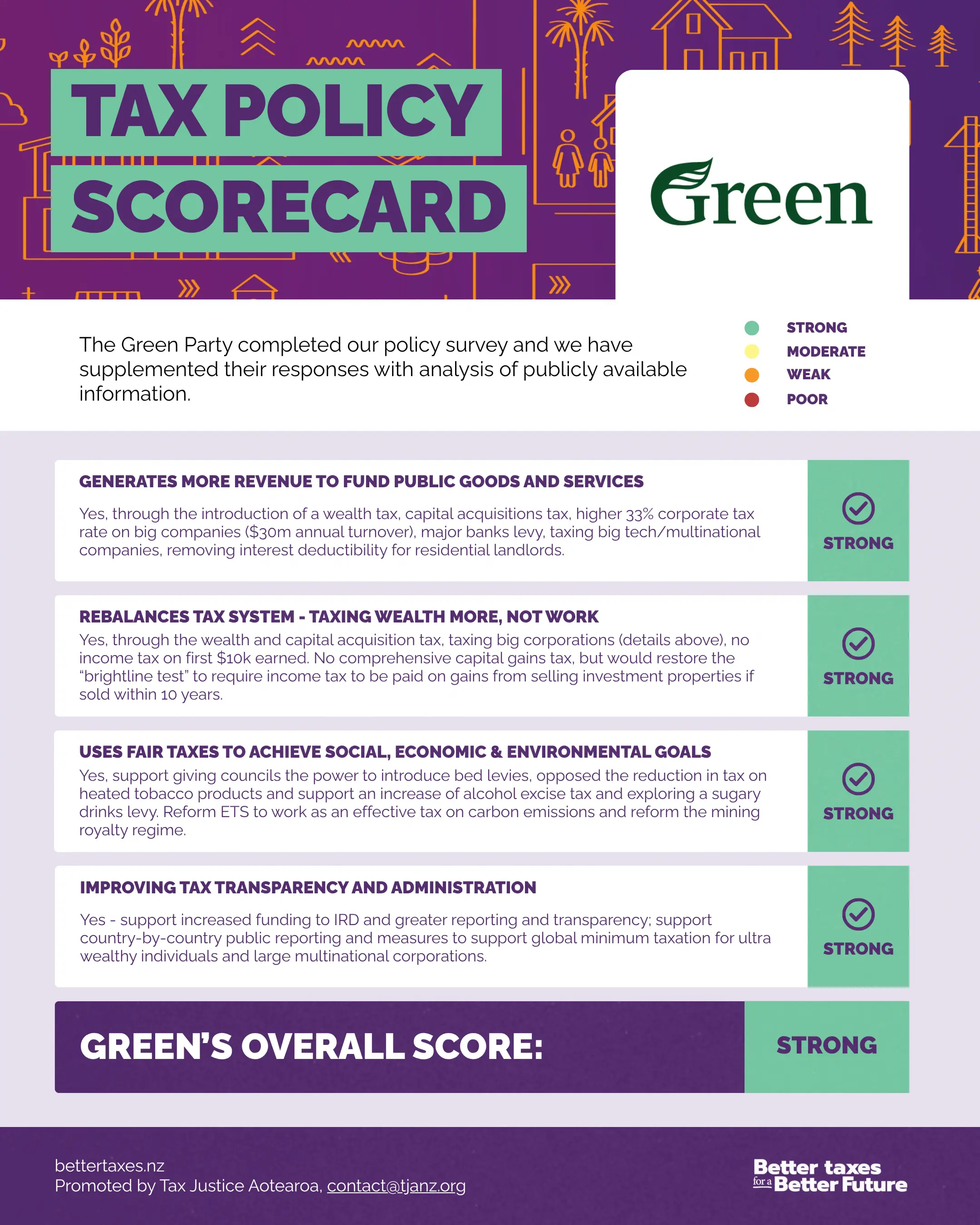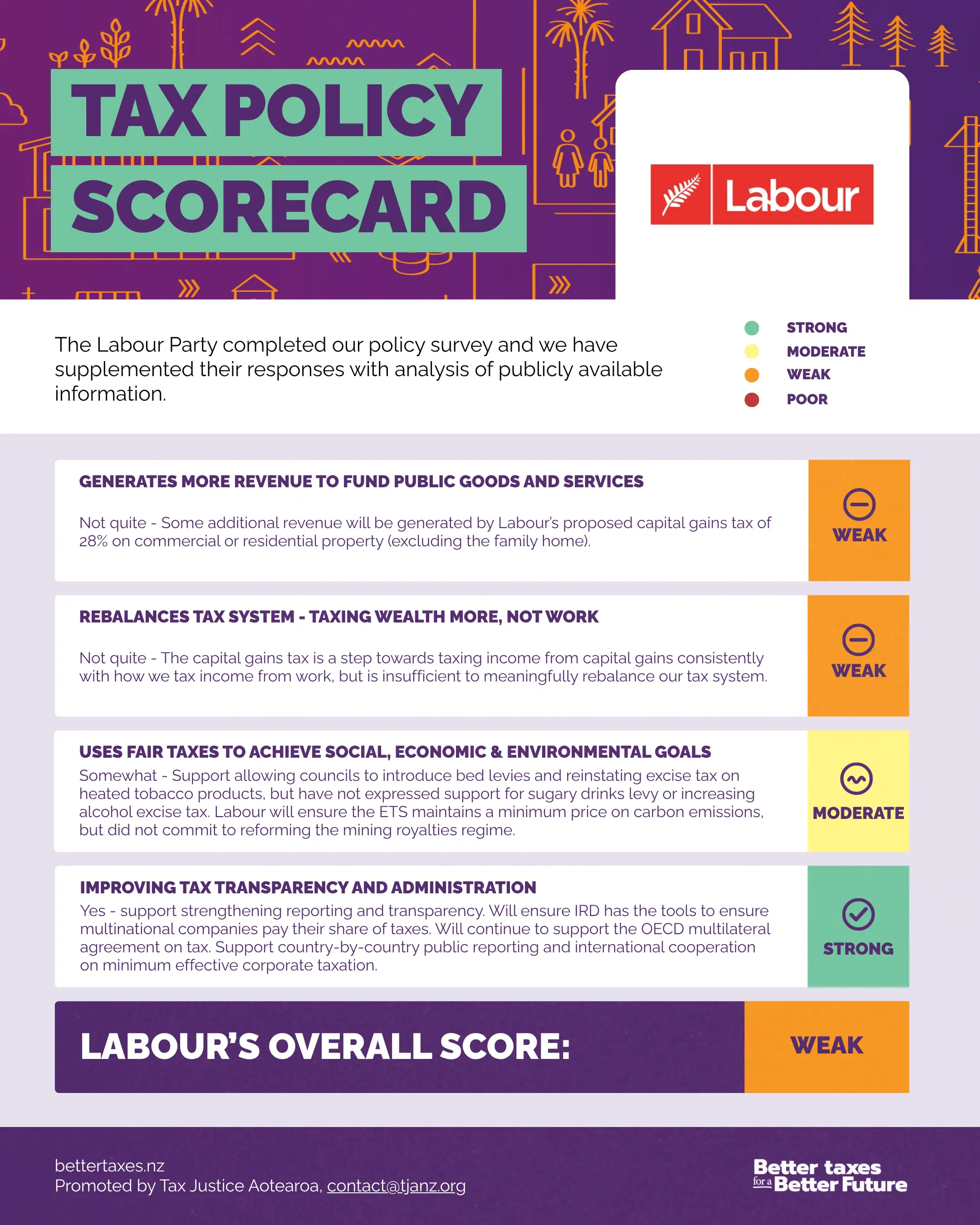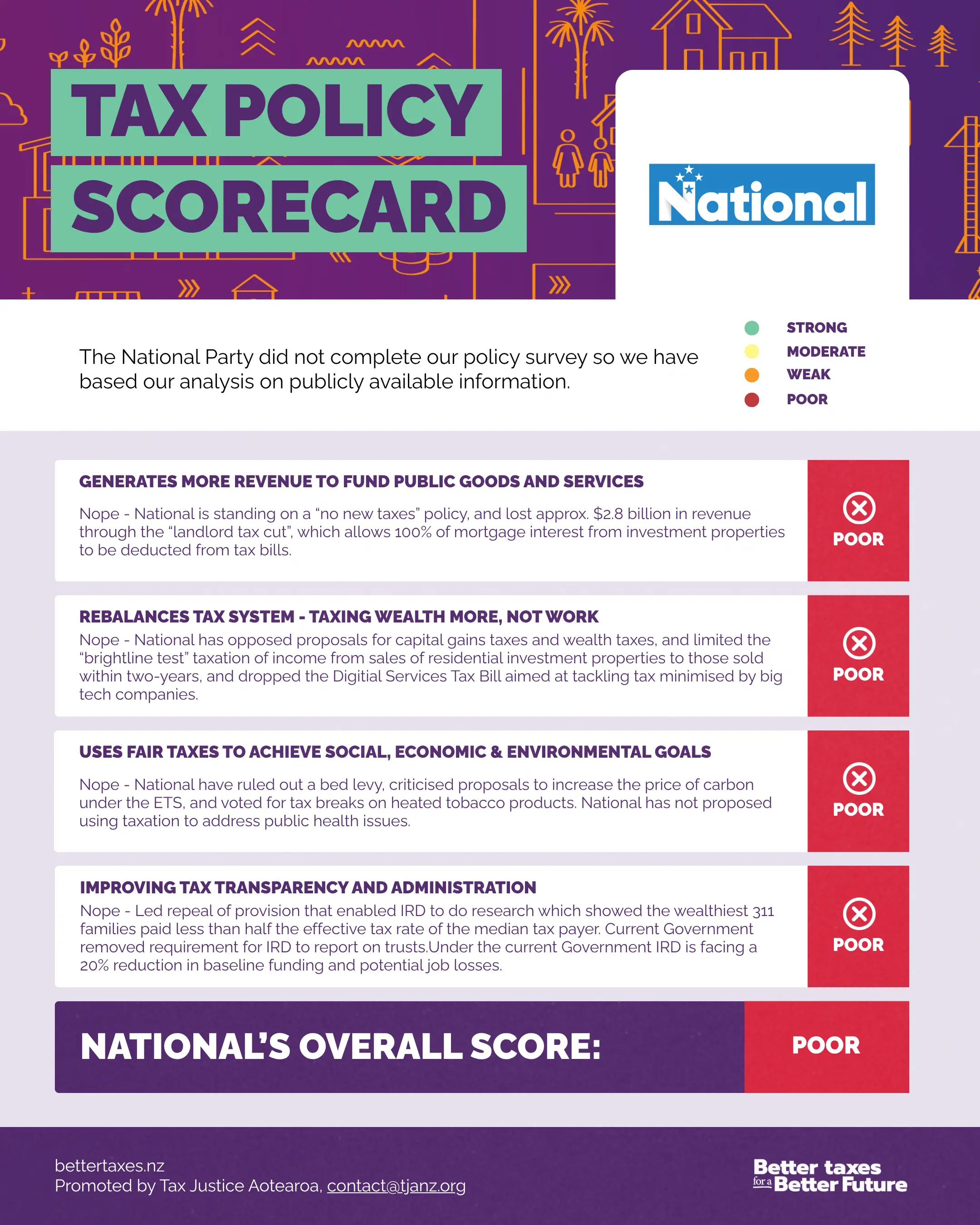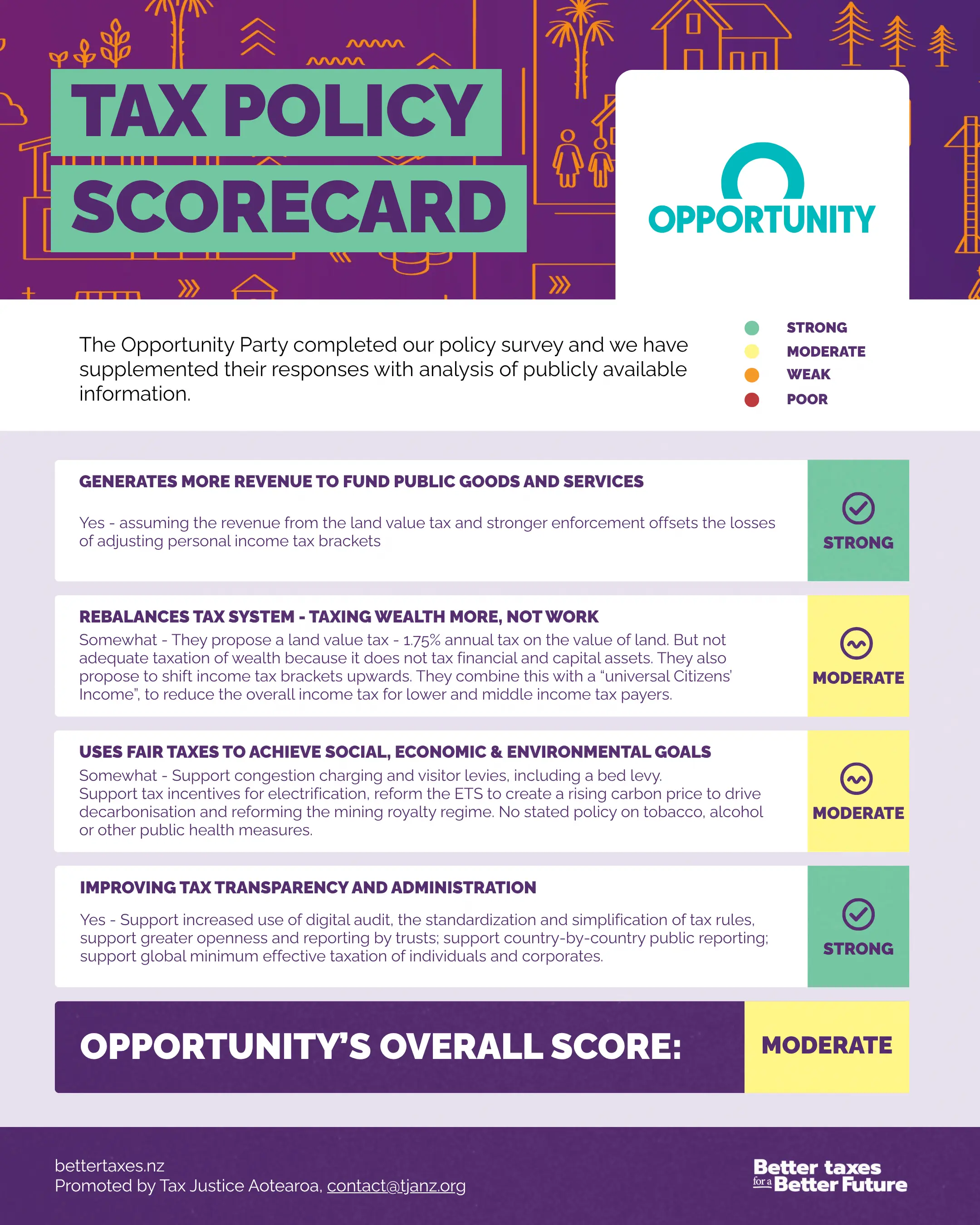
Tax Policy Scorecard

Tax is our contribution to society. It funds our hospitals, schools, public transport systems, infrastructure, looking after our environment and our people, young and old - the public goods and services we all rely on to lead to happy, healthy lives. 

But right now, our tax system is unbalanced: the wealthiest aren’t paying their fair share, and large corporations take advantage of tax loopholes. So even though hardworking people are doing our bit, our collective pool of resources is running dry; and ordinary New Zealanders are paying the price in hospital waiting rooms, when paying our power and water bills, and on public housing wait-lists. 

For years now polling has shown high levels of support for tax changes that would gather the revenue we need to fund the things that matter, and to gather that revenue more fairly. But so far successive governments haven’t been listening…. 

This election, we have an opportunity to make our support loud and clear by voting for better taxes! 

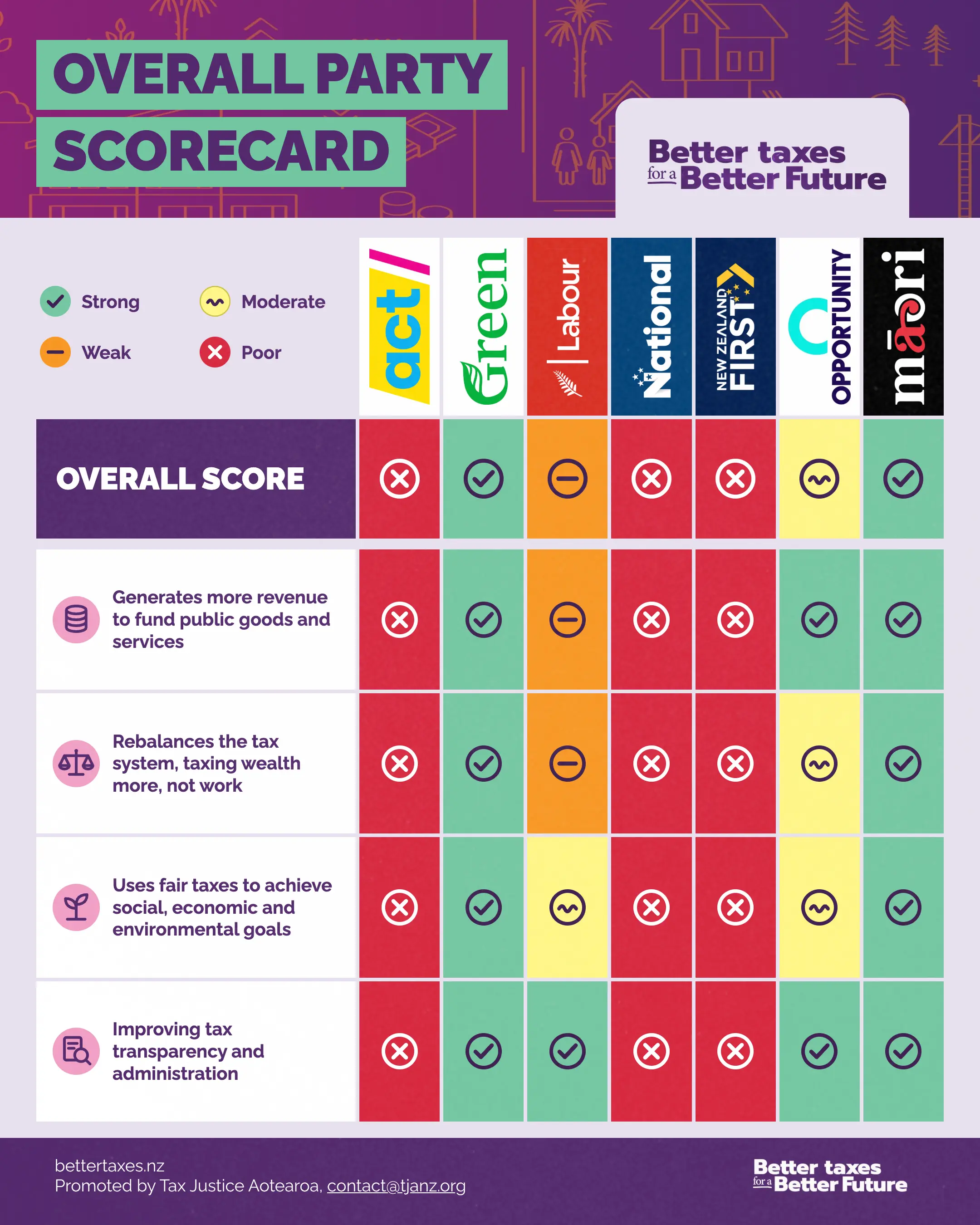
So that you can go into the ballot box informed about what the parties are proposing on tax, we’ve prepared a scorecard that rates the parties’ tax policies on four measures, using a traffic-light scale from Strong to Poor. Parties that completed our policy survey are scored on their responses, supplemented by public information. Parties that did not respond are scored on their publicly available policy, voting record and campaign statements.
What we measured

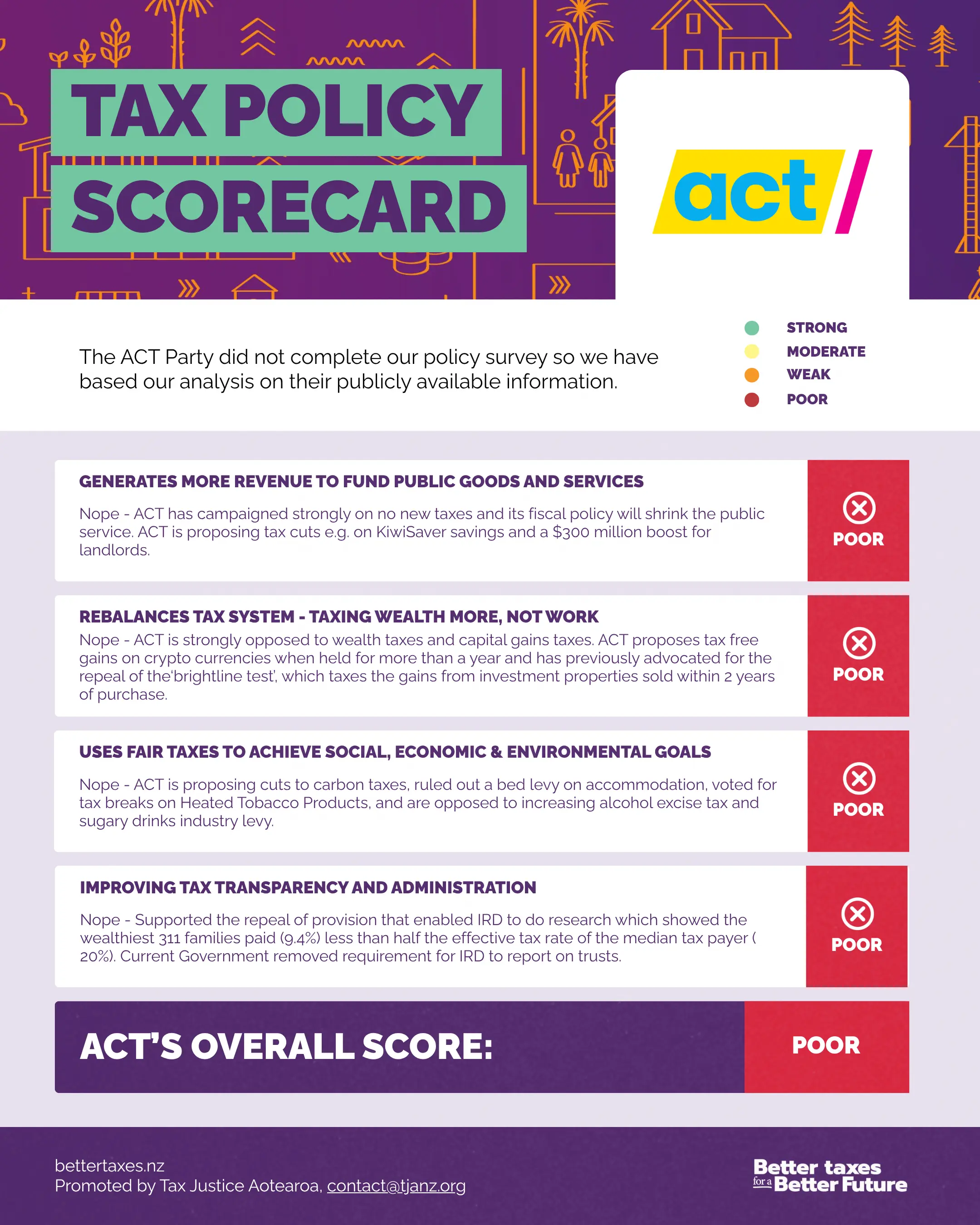
We sent a survey to all political parties and undertook our own research on the parties public statements and policy material. The parties that took part in the survey are the Green Party, Labour Party, Opportunity Party and Te Pāti Māori. The parties that didn’t accept our invitation to take part in the survey are the ACT Party, National Party and NZ First. 

We have assessed the results against four measures which we believe are fundamental to a better tax system:

This is an overall assessment of whether a party’s tax policy raises more revenue to start rebuilding our public goods and services, which are currently straining under the weight of years of underfunding.

This measure looks at how far a party shifts the tax burden from labour toward capital and wealth. It considers policy areas such as: 

  • Progressive income tax, including tax-free bands and top rates
  • Measures to address the regressive impact of GST
  • Taxation on capital gains, including the “brightline test” - for example, currently if you own an investment property for over two-years and then sell it you do not have to pay tax on the capital gains (increase in sale price compared to what you bought it for), previously the threshold was 10 years.
  • Taxes on wealth, including net wealth, inheritance and gift taxes, and the use of trusts
  • Whether large corporations pay their fair share

This measure looks at whether a party uses tax to reduce harm and support wellbeing, for example through alcohol, tobacco and unhealthy food taxes, carbon taxes and mining royalties, road user charges and accommodation/bed levies.

This measure covers investment in IRD staff and systems, stronger reporting requirements for companies and trusts, and public reporting by both IRD and multinational companies. It also covers international cooperation on tax. One area of focus is IRD’s research and investigative powers, specifically each party’s position on repealing section 17GB of the Tax Administration Act. That section allowed IRD to produce research showing the wealthiest 311 families paid an effective tax rate of 9.4%, less than half the 20% paid by the median taxpayer.

How we scored

Each party receives a rating on all four measures. 

Under each measure, we assess specific policies drawn from the party's tax policy statement and survey response (if completed), and weight them to reach the final rating. The overall score reflects the four measure ratings together.

Scoring key

  • Strong: Overall policies meaningfully advance the measure
  • Moderate: Some good steps towards the measure, but also some significant gaps
  • Weak: Not all bad, but some fundamental exclusions or gaps
  • Poor:  Policies contrary to advancing the measure

Party scorecards

Click on the party to check out their scorecard. 

About this project

This project was completed by Better Taxes staff and volunteers, and reviewed by members of Tax Justice Aotearoa Policy Advisory Committee. 

The Tax Policy Scorecard is part of Better Taxes for a Better Future campaign. We are a coalition initiative supported by over 25 organisations, aiming to promote ideas for better taxes for the public good and a better future for everyone in Aotearoa New Zealand.